Tag: pool pump
How to Service Your Pool Pump and Backwash Your Filter
Service your pool pump and backwash your filter
This is a video reference on how to service your pool pump and backwash your filter.
Service the basket
First step is to kill the power to the pump motor and being this pool is set up as flooded suction and flooded suction is below pool level with the filtration system,then we need to shut off all our valves. So we would just shut them off at 3:00 and 9:00 across the pipe, that’s all. Take your leverage tool, place it on your pump lid, give it a tap. Remove your basket, give it a tap. Empty the basket. That’s clean. Place the basket back into the pump. It can only go one way. It won’t allow you to do it any way but the right way and that’s to the hole to the front of the pump. Place the basket in.
Once again make sure this o-ring is sitting in its seat. Place the lid back onc the pump. Snug it.Come back over, make sure your return valve’s open, make sure your skimmer main drain is open, make sure your skimmer valve is open. Now that we’ve serviced the pump basket it’s time to backwash the filter.
Service the pump
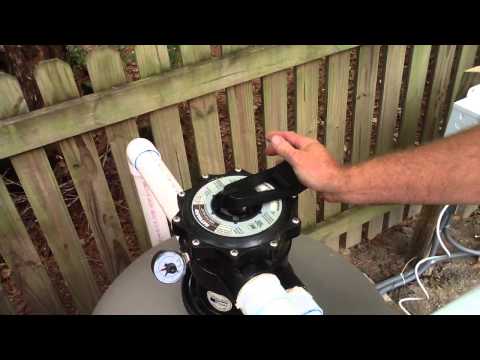
With the pump still off we will take the variable flow valve, press down on the handle, rotate it 180 to backwash. Once we’ve locked it into the backwash position we’ve come over here to the power source and set your pump on. What we’re doing in this cycle is we’re taking the water and we’re reversing the flow of water coming in the bottom of the tank come on to the sand picking up the dirt and kicking it out the waste line. Typically this takes about 40 to 60 seconds to do. The water will start off clear then it’ll cloudy up or even dirty up and then once it clears up for the second time you’re done.
So we’ve gone through the cycle. Here we will kill the power. Come back over to the variable flow valve press down on the handle put it in the rinse cycle. Power back on. Basically we want to do this for five seconds. What the rinse cycle does is force the sand to lay back down on the sand bed so we won’t have any blowback into the pool. After the rinse cycle kill your power. Pump into filter, rather variable flow valve into filter. It’s locked in. Power on. Come over here make sure we are showing pressure on the gauge. Right now we have the black operating needle showing clean. Green is clean. When that black needle hits the red it will indicate that it’s time to backwash again.
That’s just a quick video reference on how to backwash your pool
Pool Filter Systems

Ever thought about how they keep the water in a pool so clean? Actually it is a very basic system that helps remove the dirt and debris from the pool leaving the water sparkling. Filtering pool water can be viewed as a step-down process. The larger objects are removed in the first stage then the sequential steps remove smaller contaminates all the way down to any harmful bacteria. There are three main components to a filtration system for a pool.
The first step in cleaning the water involves getting rid of the bigger contaminates like leaves and sticks. This is usually done by a skimmer for above ground pools and sometimes a floor drain for in-ground pools. In either case there is a screen or a basket that allows the water and smaller particles to flow through but traps all the bigger objects. The basket is usually manually removed and emptied by the user. It is a very trivial task and only takes a matter of seconds to empty the waste.
After the water and dirt pass through the skimmer basket it will continue on to a second filter. This filter is used to collect all the other dirt and grime that the previous filter missed. Unlike the first step it does not use a screen it actually uses sand to refine the water further. As the water passes through the sand all the dirt will be trapped in the sand allowing clean water to flow back into the pool. The sand filter must be cleaned occasionally but just like before it is a very easy task. The sand filter has a valve with settings for cleaning the filter during use. It only takes a couple of moments for the filter to be back to its top capability.
After leaving the second filter the water returns to the pool. The leaves, sticks, and dirt have been removed but there is still one more step that must be taken. The smallest of all the pool contaminates must still be removed. This process actually occurs throughout the whole filtration system and pool. It involves using chemicals or salt to kill any bad bacteria and control the growth of algae. If the bacteria is not controlled it can cause serious infections in any cuts that a swimmer may have. The salt or chlorine, depending on the system, help keep the water clear and safe for swimming.
In order to keep any pool clean a progressive process that removes the debris in a step down approach must be taken in order in insure that the water is safe for swimming. The cleaning system must remove any dirt and leaves to help inhibit the growth of algae and bacteria. After the larger contaminates have been remove the chemicals ensure that the water will stay clean and clear for the swimming season.